Swiss FADP
You need to fulfill the Swiss FADP requirements? No problem.
Identify GAPs to FADP, create your Record of Processing Activities and start building out your FADP framework towards compliance.
Trusted by global enterprises












Record keeping
Processing Records
Under the revised FADP, every controller must keep a Record of Processing Activities (sometimes also called a “Processing Directory”), similar to the GDPR’s ROPA. This record provides the foundation for accountability and transparency.
The processing record must document:
The processing record must document:
 The identity and contact details of the controller (and any joint controllers)
- The purposes of data processing
- The categories of data subjects and personal data processed
- The categories of recipients, including data transfers abroad
- The retention periods, if known
- A general description of data security measures
- The basis of justification (e.g., consent, overriding private/public interest, legal duty)
Accountability
Governance and Accountability Documents
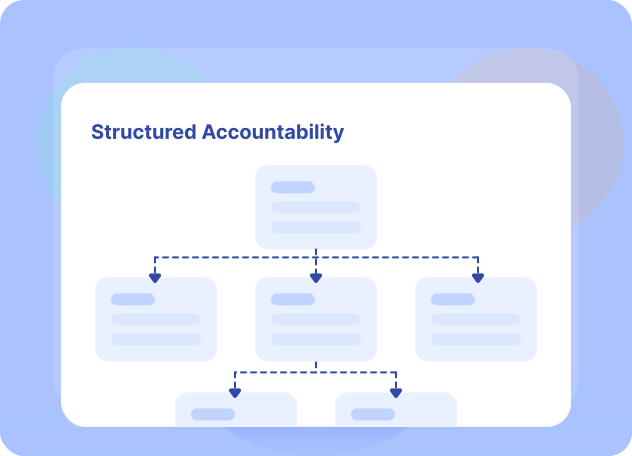
Controllers should maintain a Data Protection Policy that outlines compliance principles, roles, and responsibilities.
This document demonstrates implementation of the accountability principle and defines how data protection is integrated into daily operations.
Complementary training logs, internal audits, and data protection governance records show ongoing awareness and oversight.
This document demonstrates implementation of the accountability principle and defines how data protection is integrated into daily operations.
Complementary training logs, internal audits, and data protection governance records show ongoing awareness and oversight.
Privacy notices
Transparency and Communication Documents
To meet the information duties, controllers must provide clear Privacy Notices describing:
- Identity of the controller and purposes of processing
- Recipients and transfer details
- Rights of data subjects
- Automated decision-making, if applicable
These notices ensure that data subjects can understand and control how their data is used.
DPIA requirements
Risk and Impact Assessment Documents
For processing activities that pose a high risk to data subjects’ personality or fundamental rights, a Data Protection Impact Assessment (DPIA) must be conducted.
A DPIA Register or documentation file should include:
A DPIA Register or documentation file should include:
- Description of processing and risks
- Assessment of necessity and proportionality
- Measures to mitigate risks
- Evidence of consultation with the FDPIC if required
This serves as proof that risks were evaluated and addressed.

Third-party management
Processor and Third-Party Management Documents
Controllers are responsible for ensuring that processors provide sufficient guarantees for data protection.
A Processor Contract Register should record:
A Processor Contract Register should record:
- Processor identities and purposes
- Key contractual clauses ensuring compliance
- Any cross-border subcontractors
This register demonstrates due diligence and compliance with controller–processor responsibilities.
Breach notification
Security and Incident Management Documents
The Technical and Organizational Measures (TOMs) Documentation provides detailed information about security controls such as access management, encryption, and data backup.
Controllers must also maintain a Data Breach Register to document all personal data breaches, including:
Controllers must also maintain a Data Breach Register to document all personal data breaches, including:
- Date, nature, and scope of the breach
- Risk assessment and mitigating actions
- Notifications made to the FDPIC and affected persons
Together, these ensure evidence of compliance with Art. 8 (Data Security) and Art. 24 (Breach Notification).
Data transfers
Cross-Border Transfer Documentation
For transfers to countries without adequate protection, controllers must document:
- The destination country and legal safeguard used (e.g., standard clauses, consent, overriding interest)
- The Transfer Impact Assessment (TIA) if risks exist
This documentation supports compliance with Art. 16–17 FADP and evidences transfer due diligence.
.svg)
Ready to simplify your privacy management?
You’re in good company. Priverion replaces scattered Excel sheets and manual workflows with a unified, smart platform for privacy and InfoSec. Our team guides you from day one to ensure a smooth rollout and long-term success.
See how it works

.svg)